Italy
Last and First MenItaly’s place in the history of the First Men is shaped by a sharp contrast: a bid to recover national prestige through military power ends in defeat, while a later incident in South Italy helps draw Europe and the United States into war. The country is both a setting for the Franco-Italian War and a flashpoint in conflicts whose causes extend far beyond its borders.
Italy after the European War
After the European War, Italy passed through social disorder and a period of self-distrust. A flamboyant but sincere nationalist party then took control, presenting reform of social services and a militaristic policy as grounds for renewed national self-respect. The government’s changes were made visible in everyday public life: trains became punctual, streets were clean, and public morals were puritanical. Italy also won aviation records, making technical and military achievement part of its claim to renewed standing.
The regime directed particular attention to the young, dressing them as soldiers, training them with real firearms, and encouraging them to see themselves as the nation’s saviours. They were also used to enforce the government’s will. The movement’s unnamed dictator combined practical ability with rhetoric and crude thought; he drilled the country into greater efficiency while loudly asserting its importance and its need to expand. Because Italians had been slow to restrict population growth, the narrative presents expansion as more than a slogan: it had become a perceived material need as well as a nationalist ambition.
The Franco-Italian War
Italy’s ambitions sharpened its rivalry with France. The government coveted French territory in Africa, resented France’s leadership among the Latin peoples, and objected to the protection France gave to Italians it regarded as traitors. The immediate crisis, however, began at the frontier: a small party of Italian militia, acting without authorization, raided French territory after a supposed insult to the Italian flag. The raiders were captured, but French blood had been shed.
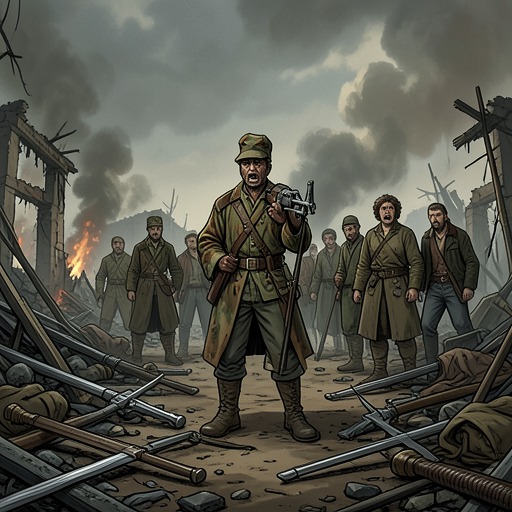
France demanded an apology and reparation in terms described as calm yet subtly offensive to Italian dignity. Italian patriots turned the demand into a point of national honour. The dictator, unwilling to apologize, instead required France to release the captured militia-men; under mounting pressure, he declared war. The conflict, remembered as the Franco-Italian War, was brief. After one sharp engagement, French forces advanced into northern Italy. Italian resistance began heroically but soon became chaotic, exposing the distance between the regime’s cultivated dream of military glory and the country’s capacity to sustain it.
Defeat and political reversal
The defeat brought the public’s disillusionment with the war into the open. Italians turned against the dictator they had themselves pressured to declare war. In an attempt to regain control of the Roman crowd, he failed and was killed. The new government quickly made peace, ceding to France a frontier territory that France had already annexed on grounds of security.
The outcome altered the model of greatness held up in Italy. The country thereafter cared less about surpassing Garibaldi’s military glory and more about emulating Dante, Giotto, and Galileo. The change did not erase the preceding nationalism or its consequences; rather, defeat redirected the aspiration for distinction from military achievement toward artistic and intellectual achievement.
Italy as a later flashpoint
Italy appears again in the origins of the Euro-American War, this time through a chain of incidents that begins with a murder in South Italy. The account links that murder to ill-considered remarks in the European press, an offensive response in the American press, and the lynching of an Italian in the American Midwest. An uncontrollable massacre of American citizens in Rome followed. The United States then dispatched an air fleet to occupy Italy; interception by the European air fleet turned the crisis into open war before it had even been formally declared.
In this later episode, Italy is not presented as the sole cause of the conflict. The violence there is one link in a sequence of retaliation and escalation between larger powers. Taken together with the earlier war against France, these episodes make Italy a recurring site where national prestige, political miscalculation, and wider rivalries acquire immediate consequences.